When i send email to an outlook.com or hotmail.com address it goes into their spam. This does not appear to be happening with any other domain. Thanks
I can think of two reasons it could happen:
-
Outlook.com has some crazy spam setting on their server. I was using one of their accounts for testing, and almost every message sent to that address went to spam. After months of messaging with Microsoft Support, (incidentally their own Support messages also ended up in the spam folder) their solution is to include the sender in the safe sender’s list, otherwise the message goes to spam. That means if you have an Outlook.com account, you need to check your spam folder every day, because there are going to be many messages there. You also cannot disable spam filtering on their server.
-
Some servers will mark messages with signatures as spam. If you have eM Client automatically inserting a signature at the end of your message, that could be the cause.
1 Like
Hi Gary, Thank you so much for your reply. I was playing around and think it might be a problem with the way eM Client automatically set up my godaddy email. I changed a setting under accounts. It had an authentication option that had checked off use identity authentication (Em Client automatically configured by email to this option. I took a chance and changed it to use the credentials of my email and password, with the server information still intact. My test wprked but i have no idea what I did - or if it will mess up anything else. What are your thoughts.
Again, thanks so much for helping me with this, Wendy
It actually does not work. still going into spam – but only the godaddy email…
Maybe the Outlook.com recipient has not added you to their safe senders list.
1 Like
it is about the technical headers in the emails sent by em Client 
it is about the technical headers in the emails sent by em Client
What part of the message header sent by eM Client is being rejected by Microsoft servers ?
Also is this an email created by you as new, or an email you are replying to or forwarding ?
The eM Client label or name: User-Agent: eMClient/10.4.0.0
And Outlook add’s I believe this to it when sent by eM Client before it goes to the receiver’s server: X-ClientProxiedBy:
The eM Client label or name: User-Agent: eMClient/10.4.0.0
And Outlook add’s I believe this to it when sent by eM Client before it goes to the receiver’s server: X-ClientProxiedBy:
User-Agent: eMClient/10.4.0.0 doesn’t automatically make sent emails go into the receiving Microsoft Spam / Junkmail folder.
I send emails all the time from many different email address’s using eM Client V10 to people at Outlook.com, Hotmail.com & Live.com and allways goes in their Inbox.
Here is an email below i composed below with V10.4.5326 from a eg: personal Gmail account to a recipients Live.com account, "and it received perfectly in the recipient’s Inbox ".
Below is the header of that sent mail where you see it has User-Agent: eMClient/10.4.0.0 as part of the sent mail header.
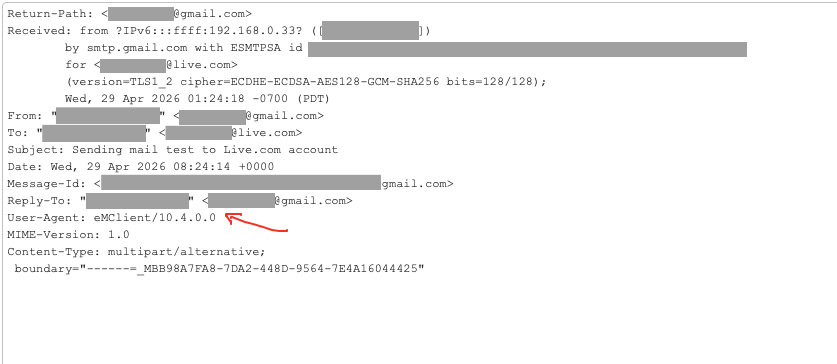
So if your emails sent to Microsoft email address’s “are going automatically in the receivers spam / junk folder”, then sounds like either the receiving mailbox has “rules setup in their mailbox” to automatically move your emails to their spam / junkmail folder, Or “they might have a blacklist setup” on your email address to automatically move your emails to their spam / junkmail folder. Or you might have some “content in the subject or body of the email” that looks suspicious.
If the recipient cannot see any rules or blacklist setup their end and the recipient has added you to their MS safe senders whitelist as @Gary advised further up, then have the recipient contact Microsoft technical support as to why your email address is going in their spam / junkmail folder.
1 Like
We can only echo the points @cyberzork made. This is not a widespread issue and there is no indication this would be caused by eM Client rather than something on the recipient’s end.
From what I found online, X-ClientProxiedBy is usually added when a proxy or other relay is used when sending a message. Nothing to do with eM Client, really.
1 Like